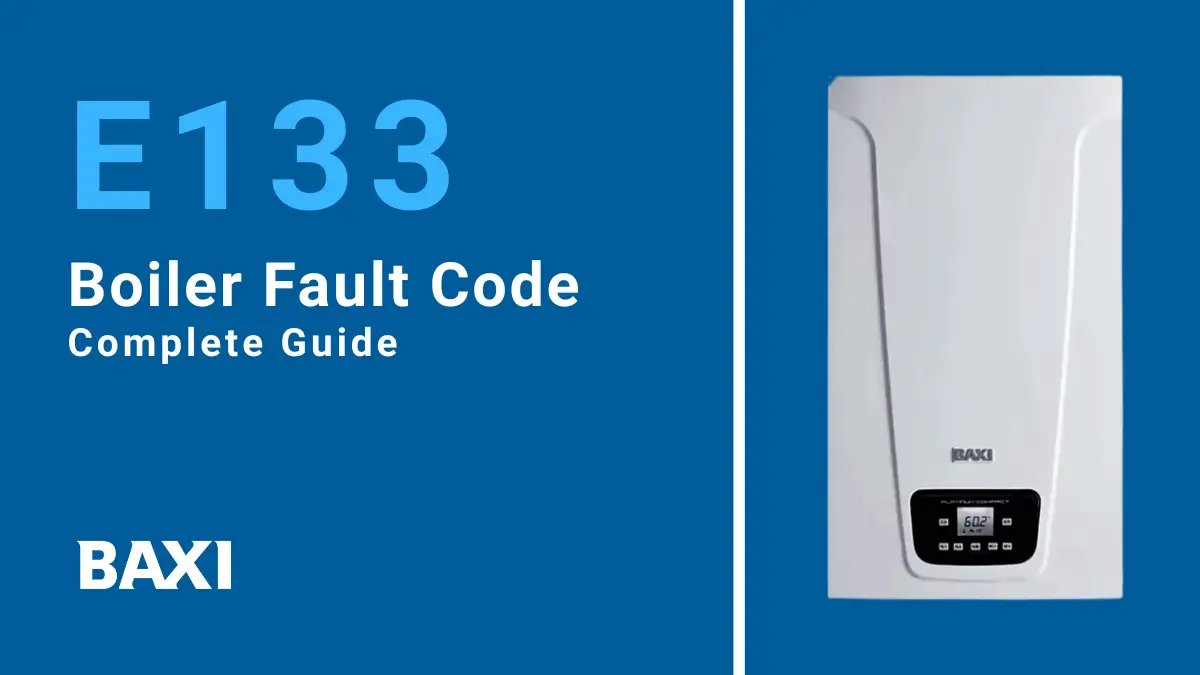
If your Baxi boiler is displaying the E133 error code, you may suddenly find yourself without heating or hot water. While this fault can be frustrating, it does not always mean there is a major problem with your boiler.
In many cases, the issue can be caused by a gas supply interruption, a frozen condensate pipe, or an ignition fault. This guide explains what the Baxi E133 error code means, its common causes, and the steps you can safely take before contacting a Gas Safe engineer.
Estimated reading time: 5 minutes
What Does the Baxi E133 Error Code Mean?
The Baxi E133 fault code indicates that the boiler has failed to ignite. When the boiler cannot establish a safe flame during startup, it enters a lockout mode and displays the E133 error on the screen.
This safety feature prevents the boiler from continuing to operate when an ignition problem is detected.
Common Causes of Baxi E133 Error Code
Several issues can trigger the E133 fault code.
1. Gas Supply Problems
A lack of gas supply is one of the most common causes of an E133 error.
Possible reasons include:
- Gas supply interruption
- Closed gas isolation valve
- Empty LPG tank
- Prepayment meter with no credit
- Gas network issues in your area
If other gas appliances in your home are also not working, the problem is likely related to the gas supply rather than the boiler itself.
2. Ignition System Faults
Your boiler relies on ignition components to create and detect a flame.
Faulty parts may include:
- Ignition electrode
- Flame sensor
- Ignition lead
- Gas valve
When these components fail, the boiler may attempt to ignite several times before locking out with an E133 error.
3. Frozen Condensate Pipe
During cold weather, condensate pipes can freeze.
When the condensate cannot drain correctly, the boiler may shut down and display an E133 fault code. This is particularly common during freezing temperatures.
4. Low Gas Pressure
If the gas pressure reaching the boiler is too low, ignition may fail.
Low pressure can be caused by:
- Gas regulator issues
- Supply pipe restrictions
- Problems within the gas network
Only a qualified Gas Safe engineer should test and diagnose gas pressure problems.
Signs Associated With E133 Fault
Along with the E133 code, you may notice:
- No heating
- No hot water
- Boiler repeatedly attempting to start
- Clicking sounds during ignition
- Boiler lockout
- Fault occurring during cold weather
How to Fix a Baxi E133 Error Code
Time needed: 1 minute.
There are a few simple checks homeowners can safely perform.
- Reset the Boiler
Try resetting the boiler following the instructions in your user manual.
If the fault was temporary, the boiler may restart normally.
However, avoid repeatedly resetting the boiler if the fault continues to return. - Check the Gas Supply
Verify that:
Other gas appliances are working
Gas valves are open
Prepayment meters have sufficient credit
LPG tanks contain fuel
If there is no gas supply to the property, the boiler will not ignite. - Inspect the Condensate Pipe
During freezing weather, inspect the external condensate pipe.
If it appears frozen:
Use warm (not boiling) water to thaw the pipe.
Ensure water can drain freely.
Reset the boiler.
Many E133 faults during winter are resolved once the condensate pipe has thawed.
What Should You Not Do?
Never attempt to:
- Remove the boiler casing
- Repair gas components
- Adjust the gas valve
- Work on electrical connections
- Replace ignition parts yourself
Gas appliances should only be repaired by qualified Gas Safe registered engineers.
When Should You Call a Gas Safe Engineer?
Contact an engineer if:
- The fault returns after resetting
- Gas supply appears normal but the boiler will not ignite
- The condensate pipe is not frozen
- The boiler repeatedly locks out
- You suspect an internal component failure
Professional diagnostic testing is often required to identify the exact cause of recurring E133 faults.
How Much Does It Cost to Repair an E133 Fault?
Repair costs vary depending on the cause.
Simple issues such as a frozen condensate pipe may cost nothing to resolve. However, faults involving ignition components, gas valves, or electrical parts may require replacement parts and labour.
The final repair cost depends on the specific component that has failed.
Does E133 Mean You Need a New Boiler?
Not usually.
Most E133 faults can be repaired without replacing the entire boiler.
However, replacement may be worth considering if:
- The boiler is over 10 years old
- Repairs are becoming frequent
- Multiple components have failed
- Running costs are increasing
A professional assessment can help determine whether repair or replacement offers the best value.
Can Annual Servicing Help Prevent E133 Faults?
Regular boiler servicing can help reduce the risk of ignition-related problems.
During a service, an engineer can:
- Check ignition components
- Inspect gas pressures
- Clean essential parts
- Identify wear before breakdowns occur
Annual servicing improves reliability and helps keep your heating system operating efficiently.
Final Thoughts
A Baxi E133 error code means the boiler has failed to ignite safely. The most common causes include gas supply problems, ignition faults, low gas pressure, and frozen condensate pipes.
Start with simple checks such as resetting the boiler, verifying the gas supply, and inspecting the condensate pipe. If the fault persists, contact a Gas Safe engineer for a professional diagnosis.
Addressing the issue early can help restore your heating and hot water quickly while preventing further damage to your boiler.
FAQ’s
The E133 fault code indicates that your Baxi boiler has failed to ignite. This usually happens due to a gas supply issue, ignition fault, or a frozen condensate pipe.
Yes, you can try resetting the boiler once using the manufacturer’s instructions. If the error returns after resetting, further investigation by a Gas Safe engineer may be required.
Yes. During cold weather, a frozen condensate pipe can prevent the boiler from operating correctly and trigger the E133 fault code. Thawing the pipe safely may resolve the issue.
The E133 fault itself is a safety lockout designed to protect the boiler. However, if the fault is caused by a gas-related issue, it should be checked by a qualified Gas Safe engineer as soon as possible.
Regular annual servicing, keeping the condensate pipe protected from freezing, and ensuring a reliable gas supply can help reduce the risk of future E133 faults.