Low boiler pressure is one of the most common reasons behind boiler problems. Over time, a boiler can lose pressure due to leaks or internal faults, which can lead to no hot water or central heating. It’s normal for boiler pressure to drop occasionally, so homeowners and tenants should know how to spot low pressure and resolve it quickly to restore heating and hot water.
What is boiler pressure?
Boiler pressure is the measurement of the water and air balance within a closed heating system, ensuring efficient heat distribution. The ideal operating range for most domestic boilers is 1.0 to 1.5 bar when cold under 1 bar and up to 2.0 bar when hot. Pressures above 2.5-3 bar are too high, while below 0.5-1 bar is too low
Most central heating components carry a volume of water, but unlike older style systems your new boiler doesn’t use a water storage tank (header tank) in the loft. Instead of the header tank your system will use an expansion
Because water volume increases and decreases with temperature the expansion vessel absorbs the pressure changes (pressure rise) of water when your new boiler heats up the system water.
For boilers to run efficiently and safely, they must operate within a specific pressure range (0.7 bar to 2.5 bar). If the pressure occasionally drops below this range, it can usually be topped up using a filling valve located on the system.
What are the signs your boiler pressure has dropped?
Boiler pressure is something you can check yourself, but most people only look at it after they notice a problem with hot water or central heating.
Check your boiler pressure if you notice any of these:
- You run a hot tap, but the water doesn’t warm up
- Your radiators aren’t heating up when the heating is switched on
- The boiler has switched itself off or is showing an error code
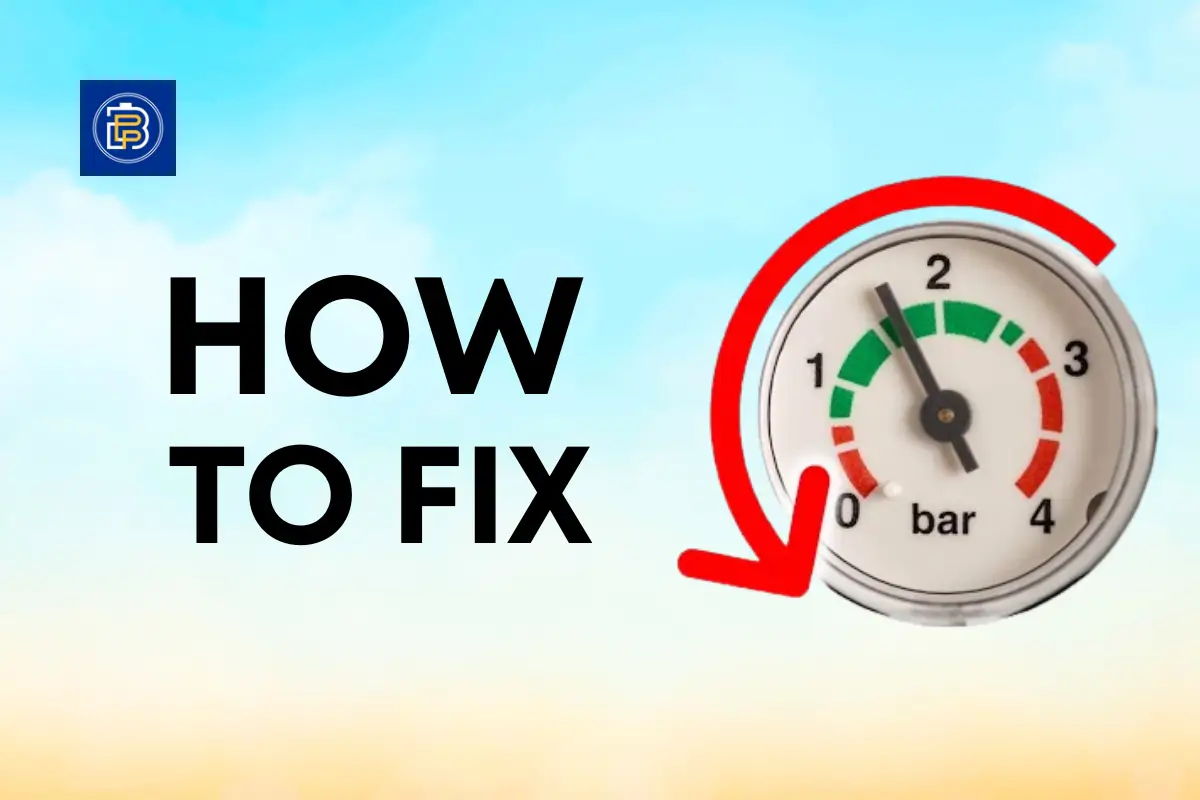
What should your boiler pressure gauge read?
When the boiler is off and cold, the pressure should usually sit around 1 to 1.5 bar.
When the boiler is on and running, the pressure should rise slightly, typically to around 1 to 2 bar.
If you’re not sure about the exact numbers, the key check is that the needle/indicator sits in the green zone
How do I check if my boiler pressure is low?
To confirm whether low pressure is likely causing the issue, you need to check the boiler’s pressure gauge or digital display.
1. Find the pressure gauge or display
Many boilers have a round, clock-style gauge with numbers (often around 1.0 to 4.0) and coloured sections.
Some modern boilers show pressure digitally instead of a clock-style gauge. If you’re unsure, check the user manual.
2. Read the gauge
Green zone = pressure is at the correct level
Red zone = pressure is too low (below the green zone) or too high (above the green zone)
3.Use the manual if there’s an error code
Many boilers show a fault code on the screen. Your boiler manual will confirm whether that code relates to low pressure.
In general, if the pressure reading is below 1 bar, it usually indicates the boiler has lost pressure.
Is it dangerous if a boiler loses pressure?
Low boiler pressure usually isn’t dangerous in most cases, but it can stop the boiler from heating your home and hot water properly.If the pressure drops too low, many boilers will shut down and show an error code. This helps highlight the issue so you can take the right steps to resolve it.
If the pressure is too high, systems have a built-in safety device to release excess pressure so it doesn’t become dangerous. Even so, if your manual indicates the pressure is too high, bleeding radiators may help bring it back down.
What causes a boiler to lose pressure?
1. Bleeding radiators recently
If you’ve bled your radiators, air and/or water is released from the system, which can reduce pressure. After bleeding, check the gauge and top up if needed.
2. A leak somewhere in the heating system
Leaks can happen anywhere in the network of pipes, joints, and radiators. If a leak isn’t found and fixed, the boiler will keep losing pressure.
3. A leak inside the boiler
Possible boiler-related causes mentioned include:
- A pressure reducing valve (PRV) not working correctly (sometimes showing a wet patch where it terminates)
- A damaged expansion vessel
- A filling loop valve not fully tightened
- A diverter valve not secure
If you see water dripping from the boiler or pooling underneath, switch the boiler off to prevent further damage and the risk of short-circuiting, and arrange an inspection.
How do I find a leak in my heating system?
Leaks are often found at vulnerable points such as radiator connections, joints, and valves.
Look out for signs such as:
- staining or discolouration
- paint bubbling or flaking
- softened or rotting wood
- rust marks
- swelling or bulging
- skirting boards lifting or warping
- other clear water damage
Because condensation can sometimes look like a leak, carefully wipe the pipework dry and place something underneath (like a plate or bowl) to see if water drips and collects.
If there’s no visible sign around radiators or joints, a leak could be hidden inside a wall, under floors, or inside the boiler.
You shouldn’t attempt to repair leaks or open the boiler casing unless trained. Arrange for a Gas Safe registered engineer to diagnose and repair the issue.
If you’ve found an active leak, place towels and a bowl underneath to help reduce further damage until it’s fixed.
How do I fix low boiler pressure?
Fixing the underlying cause (like a leak or faulty component) is the long-term solution, but you can usually restore pressure by topping up using the filling loop.
Before you start
- Turn the boiler off and let it cool down. Pressure readings should be based on a cold system for accuracy and safety.
- It’s recommended to check the boiler manual or the manufacturer’s guidance for your specific model.
Step 1: Locate the filling loop
This is the connection (often a silver flexible hose/pipe) between the boiler and the cold water supply. The exact location varies by boiler model.
Step 2: Open the valves slowly and top up
Depending on your setup, you may have:
- An isolation valve you turn with a flat head screwdriver
- A handle valve you turn by hand
Open the valve slowly to let water into the system and watch the pressure gauge as it rises.
Continue until the pressure reaches around 1 to 1.5 bar (or the green zone).
Step 3: Close both valves
- Once the pressure is back in the correct range, close the valves fully.
- Turn the boiler back on. Some boilers may require a reset, depending on the model.
After topping up
Keep an eye on the pressure over the next couple of days. If it drops again, that usually suggests a leak or fault that needs professional engineer.
What if the boiler keeps dropping pressure after repressurising?
If topping up doesn’t stop the pressure from falling, there’s likely a more serious issue (such as a leak or a faulty component). At that point, it’s best to contact a Gas Safe registered engineer to inspect and fix the cause safely.